SOP for Early Childhood Education: Courses & Universities
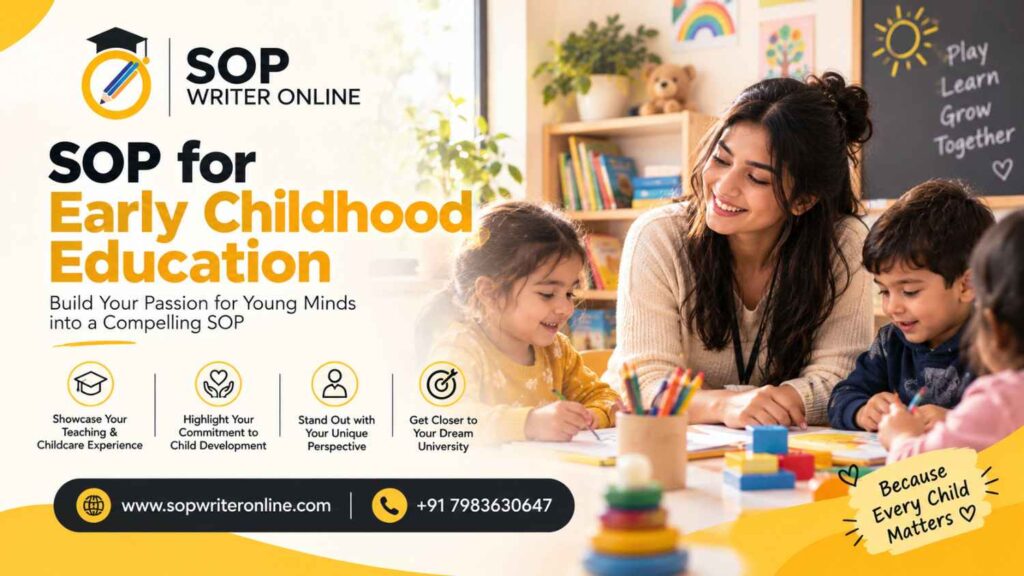
An SOP for early childhood education is a Statement of Purpose that explains why you want to work with young children, what experience you have, and how the course will shape your teaching or research career. Admission committees use it to judge your understanding of child development, your commitment to the field and your fit with the program.
For Instant SOP Writing Help: What’s App us +91 7983630647
Need Help With Your SOP or Personal Statement?
Stuck on your Statement of Purpose, personal statement or admission essay? Get professional help to turn your story, academic background and career goals into a focused, specific and well-structured document that matches your course, your university and its word limit.
 Call Now
 WhatsApp Us
SOP for Early Childhood Education vs Personal Statement
An SOP is goal-led. It covers your academic background, classroom or childcare experience, the program you chose and your career plan. A personal statement is story-led. It explains what shaped your interest in children’s learning and what you believe about teaching. US, Canadian, Australian and Indian universities usually ask for an SOP, while UK universities often ask for a personal statement. Many programs use both terms for one document, so follow the prompt on the application page.
Some programs use other names. The University of Hawaii’s Master of Early Childhood Education asks for a Statement of Objectives that explains your interest in the program, the qualities that will help you succeed, and how the program supports your career goals. hawaii
How to Structure Your Early Childhood Education SOP
Committees in this field look for real contact with children, so build the SOP around experience. Use this structure:
- Opening: One moment with a child that changed how you see learning, such as a reading breakthrough or a child who finally joined a group activity.
- Background: Your degree and the subjects that prepared you, such as psychology, child development or education.
- Experience: Nursery, preschool, tutoring, NGO or volunteer work, with what you learned from each.
- Teaching philosophy: Your approach, for example play-based learning, Montessori, Reggio Emilia or inclusive practice.
- Why this course: Named modules, placements and faculty.
- Career goals: Teacher, centre director, curriculum designer, policy advisor or researcher.
Use specific examples instead of general statements about loving children.
SOP for Early Childhood Education: Undergraduate (BA / BEd)
At UG level, committees look for patience, responsibility and genuine interest in children, not teaching experience. Mention babysitting, tutoring, summer camps, school volunteering, NGO work, or helping younger siblings and cousins. Connect this to subjects such as Psychology, Biology or Languages.
Explain what you hope to learn about child development, learning through play and communicating with families. Describe why you want a long-term career in early years, and what kind of setting you imagine working in.
Keep the tone warm but specific. One short, real classroom or community moment works better than three paragraphs about passion.
Ideal length: 500 to 700 words, or the university’s limit.
SOP for Early Childhood Education: Masters (MA / MEd / MTeach)
A Masters SOP needs direction. Decide whether you want to teach, lead, research or work in policy, and explain why. Describe your classroom or childcare experience, any inclusion or special-needs exposure, and one challenge you handled with children or parents.
Check what the program includes. Teachers College at Columbia, for example, requires student teaching and practicum field experiences in its early childhood programs. Mention how you will use such placements. If you want to teach, state whether you need a teaching license or certification, since this affects which course you should choose. columbia
Applicants from other fields should explain the change in direction and show relevant volunteering or study.
Ideal length: 500 to 1000 words, depending on the program.
SOP for PhD in Early Childhood Education
A PhD SOP is built around research. State a clear question, for example “How does play-based learning affect language development in multilingual toddlers?” or “How do early years policies affect rural access to preschool?”, and show that you know the existing studies.
Summarize your thesis or pilot study, your methods, such as classroom observation, interviews, surveys or case studies, and any publications or conference papers. Name professors whose work matches yours and explain how you would contribute to their projects.
Contact supervisors before applying, because supervisor fit often matters more than the university’s ranking.
Ideal length: 800 to 1200 words, or as the university specifies.
Top Universities for Early Childhood Education
Program names, licensing rules and deadlines change. Verify details on official websites.
| Country | University | Popular Course |
|---|---|---|
| USA | Teachers College, Columbia University | MA Early Childhood Education |
| USA | University of Illinois Urbana-Champaign | Early Childhood Education (Birth to Grade 2) |
| USA | University of Illinois Chicago | MEd Early Childhood Education |
| USA | University of Massachusetts Boston | Early Childhood Education (licensure and non-licensure) |
| USA | Kansas State University | Early Childhood Education |
| UK | University College London | MA Early Years Education |
| UK | UWE Bristol | Education (International Early Years) |
| UK | Bath Spa University | Education (Early Childhood Studies) |
| Canada | University of British Columbia | Early Childhood Education |
| Canada | University of Toronto (OISE) | MA Child Studies and Education |
| Canada | Toronto Metropolitan University | Master of Early Childhood Studies |
| Australia | University of Melbourne | Master of Teaching (Early Childhood) |
| Europe | Marino Institute of Education | Master in Education Studies (Early Childhood Education) |
| Asia | University of Hong Kong | MEd Early Childhood Education |
| Asia | Education University of Hong Kong | MEd (Early Childhood Education) |
| India | Ambedkar University Delhi | MA Early Childhood Care and Education |
Common SOP Mistakes to Avoid
- Writing “I love children” without a single example.
- Describing duties instead of what you learned.
- Ignoring licensing or certification requirements.
- Using the same SOP for every university.
- Making big claims such as “I will transform education.”
- Leaving typos or placeholder text in the final draft.
Need Help with Your SOP, Personal Statement, LOM or Essay?

For Instant SOP Writing Help: What’s App us +91 7983630647
At SOP Writer Online, we provide professional writing assistance for
Essays, Statements of Purpose (SOPs), and Personal Statements for university applications worldwide.
Whether you’re applying to universities in the USA, UK, Canada, Australia, or other countries, our team can help you present your academic journey, personal experiences, achievements, and future goals through a compelling application essay.
Our Services Include:
- Supplemental & Optional Essays
- Statement of Purpose (SOP)
- Personal Statements
- University Application Essays
- LOR Writing
Need help with your next application? Get in touch with us today!
🌐 Website: www.sopwriteronline.com
📞 Contact / WhatsApp: +91 7983630647
FAQs
How long should an SOP for early childhood education be?
Most programs ask for 500 to 1000 words, and a PhD can run up to 1200 words. Always follow the university’s stated limit.
Do I need teaching experience for an early childhood education SOP?
Not always. Volunteering, tutoring, NGO work and childcare can all show practical interest. Some licensure programs may ask for more, so check the requirements.
Can I use the same SOP for multiple universities?
No. Keep the same base story, but rewrite the course, modules, placements and faculty section for each application.
Is an SOP the same as a personal statement for early childhood education?
They overlap, but an SOP is goal-focused while a personal statement is story-focused. Follow each university’s prompt.
What should I include in an SOP for early childhood education?
Include your motivation, background, child-related experience, teaching philosophy, why you chose the course, and your career goals.
How do I start an SOP for early childhood education?
Start with a specific moment with a child that shaped your view of learning. Avoid openers like “Since childhood, I have loved children.”
Can I apply for early childhood education with a non-education degree?
Yes, many Masters programs accept applicants from other subjects. Explain why you are changing fields and show relevant experience with children.
Should I mention my teaching philosophy in the SOP?
Yes, briefly. One or two sentences about your approach, supported by an example, show that you have thought about how children learn.
Should I mention specific modules and professors in my SOP?
Yes. Naming two or three modules, placements or professors shows genuine research. For a PhD, it is essential.
What are the most common mistakes in an SOP for early childhood education?
The most common mistakes are generic passion statements, no real examples, ignoring certification rules, ignoring word limits and using one SOP for all universities.
Conclusion
A strong SOP for early childhood education connects real experience with children, a clear teaching or research approach and a specific course. Tailor it to every program, check licensing requirements and proofread before submitting.









Post Comment