SOP for University of Ottawa | Letter of Intent, Personal Statement and Study Visa Guide
SOP for University of Ottawa applicants should understand the difference between a Statement of Purpose (SOP), a Letter of Intent (LOI) and a Personal Statement (PS) before preparing their application documents. The University of Ottawa offers undergraduate and graduate programmes with different admission requirements, and the supporting documents required can vary by faculty, degree and programme. Whether you are applying for a bachelor’s degree, master’s programme or PhD, your application documents should clearly communicate your academic background, motivation, relevant experience and future goals. International students should also prepare a convincing study plan for their Canadian study permit application.
Need Help With Your SOP for University of Ottawa?
Applying to the University of Ottawa? Get professional assistance with your Statement of Purpose, Letter of Intent (LOI), Personal Statement and Canada study visa SOP. We help you organise your academic background, explain your programme choice and present your future goals clearly through documents tailored to your profile and application requirements.
 Call Now
 WhatsApp Us
What Is an SOP for the University of Ottawa?
A Statement of Purpose is a document that explains why an applicant wants to pursue a particular programme, how their previous education or experience has prepared them for it, and how the qualification relates to their future career goals.
However, applicants should not assume that the University of Ottawa requires a document specifically titled SOP for every course. Depending on the programme, applicants may need to submit a Letter of Intent, Statement of Interest, Personal Statement or another programme-specific document.
Before writing, check the official University of Ottawa graduate admissions guidelines and the admission requirements for your chosen programme.
A well-prepared application document should demonstrate a clear connection between your previous academic experience, your chosen programme and your long-term professional objectives.
Does the University of Ottawa Require a Letter of Intent or Personal Statement?
The document required depends on the programme to which you are applying. Although a Letter of Intent, SOP and Personal Statement can cover similar themes, they should not automatically be treated as interchangeable documents.
1. Letter of Intent (LOI)
A Letter of Intent is commonly used in University of Ottawa graduate admissions. It allows applicants to explain their academic interests, professional objectives and reasons for choosing a particular programme.
Depending on the course, a strong Letter of Intent may cover:
- Academic background: Relevant degrees, coursework and academic preparation.
- Motivation: Why you want to pursue the selected programme.
- Programme suitability: How the course curriculum, specialisations or research opportunities match your interests.
- Relevant experience: Employment, research, projects, internships or other relevant activities.
- Future goals: How the qualification will contribute to your professional or academic development.
For research-based programmes, applicants may also need to discuss their proposed research topic, research interests and potential supervisors.
For example, the University of Ottawa’s Faculty of Education provides specific Letter of Intent guidelines for several graduate programmes, including research interests, professional goals and previous experience. Its requirements include a maximum length of two pages for the programmes covered by those guidelines.
Read the University of Ottawa Letter of Intent guidelines before preparing your document.
2. Personal Statement (PS)
A Personal Statement focuses on the applicant’s individual journey, motivations, experiences and suitability for the intended course.
When a programme requests a Personal Statement, applicants may need to explain:
- What motivated them to choose their academic field.
- Which experiences influenced their educational or professional direction.
- What skills, achievements or personal qualities prepare them for the programme.
- How the course connects with their future plans.
- What perspectives or experiences they would bring to the university community.
The emphasis depends on the exact application instructions. Some programmes may request a Personal Statement, while others may use different terminology or require a more research-focused document.
Important: Do not submit an SOP, LOI or PS simply because you assume one is required. Always follow the document name, word limit, format and content instructions specified by the relevant programme.
How to Write an Effective SOP for the University of Ottawa
If your chosen programme requests a Statement of Purpose or a similar application essay, use the following approach to develop a clear, relevant and convincing document.
1. Begin With a Clear Academic Motivation
Introduce your academic background and explain what led you to choose your field of study.
Avoid generic openings about being passionate since childhood unless that statement reflects a genuine experience that is relevant to your application.
Instead, identify a specific academic interest, practical experience or professional goal that explains your decision to pursue further education.
2. Explain Your Academic Background
Discuss the qualifications, subjects, projects or research experience that have prepared you for the programme.
Rather than listing every subject from your transcript, highlight the experiences that demonstrate your readiness for the course.
If you have lower grades, an academic gap or a change in your field of study, explain the circumstances honestly and briefly where relevant.
3. Explain Why You Chose the University of Ottawa
A convincing application should demonstrate that you have researched the university and the programme rather than selected it solely because it is in Canada.
Consider discussing relevant curriculum components, research opportunities, specialised facilities or faculty interests that align with your objectives.
For research-based programmes, investigate the department’s research areas and potential supervisors where applicable.
Use accurate, programme-specific details. Avoid praising the university with generic statements that could apply to any institution.
4. Connect the Programme With Your Career Goals
Explain what you intend to do after completing the degree and how the knowledge or skills gained will support those plans.
Your goals should be realistic and consistent with your previous education, professional experience and chosen programme.
For example, an applicant pursuing a master’s degree in data science might explain how advanced training in statistical modelling and machine learning supports their plans to work in data analytics or research.
The example should be adapted to the applicant’s actual background and objectives.
5. Maintain a Logical Structure
Your document should progress naturally from your academic background and motivation to programme suitability and future goals.
Use specific examples wherever possible, maintain a professional tone and remove repeated statements.
Follow the university’s prescribed word limit, page limit and formatting requirements rather than relying on a universal SOP template.
Common Mistakes to Avoid in a University of Ottawa SOP
Even applicants with strong academic records can weaken their application through poorly structured or generic writing.
Avoid these common mistakes:
- Using a generic SOP: A document written for another university may not address the University of Ottawa programme’s specific requirements.
- Repeating the CV: An application essay should explain the significance of relevant experiences instead of merely listing them.
- Making unsupported claims: Statements about research facilities, courses or professors should be accurate and relevant.
- Ignoring academic inconsistencies: Where appropriate, explain significant gaps or unusual circumstances clearly and honestly.
- Overstating career ambitions: Your future plans should make sense in light of your chosen degree and existing experience.
- Ignoring document instructions: An excellent essay can still fail to meet the requirements if it exceeds the word limit or omits requested information.
- Using copied or fabricated content: Your application should accurately reflect your own experiences, qualifications and intentions.
What Is a Canada Study Visa SOP?
Admission to the University of Ottawa and approval of a Canadian study permit are separate processes.
A university application document explains your suitability for the academic programme. A study permit application, on the other hand, must establish that you meet Canada’s immigration requirements.
A Canada study visa SOP, often referred to as a study plan or letter of explanation, can help applicants present their educational background, programme choice, financial circumstances and future plans coherently.
The exact supporting documents depend on the applicant’s circumstances and the applicable immigration requirements.
What Should a Canada Study Visa SOP Include?
A well-organised study plan may address the following points:
1. Educational background: Summarise your previous qualifications, relevant academic achievements and any important gaps in your education.
2. Reasons for choosing the programme: Explain how the selected course relates to your previous studies, experience or professional development.
3. Reasons for choosing Canada: Explain why the programme in Canada is appropriate for your objectives, using relevant and accurate details.
4. Reasons for choosing the University of Ottawa: Discuss the specific academic features that influenced your decision.
5. Financial preparedness: Explain how your tuition fees, living expenses and other relevant costs will be covered, supported by genuine documentation.
6. Career plans: Describe your intended career direction and how the qualification fits into that plan.
7. Immigration compliance: Address the requirement to leave Canada at the end of your authorised stay unless you obtain legal permission to remain longer. Your explanation must be consistent with your actual circumstances and supporting documents.
A study permit SOP should not replace required financial documents, proof of acceptance or other mandatory evidence. Its purpose is to explain the applicant’s circumstances and connect the information provided across the application.
For further guidance, read our detailed guide on Canada study visa SOP:
Why Are Canadian Study Permit Applications Refused?
A study permit application can be refused for several reasons. Approval is not guaranteed simply because an applicant has received an admission offer from a recognised university.
According to Immigration, Refugees and Citizenship Canada (IRCC), an application may be refused if the applicant does not meet the relevant requirements, including demonstrating sufficient financial resources or satisfying the officer that their main purpose in Canada is to study and that they will leave at the end of their authorised stay.
Common concerns include the following.
1. Insufficient Proof of Funds
Applicants must demonstrate that they can meet the applicable financial requirements for their studies and stay in Canada.
Unclear funding sources, inadequate supporting documents or inconsistencies between financial evidence and the information provided may raise concerns.
2. An Unclear Study Plan
If the applicant cannot explain why the selected programme makes sense given their previous education, experience or future objectives, the study plan may not adequately address the officer’s concerns.
A clear explanation should establish a logical academic progression rather than simply repeat the university’s course description.
3. Weak Programme Selection Rationale
Applicants should explain why the chosen programme is appropriate for their individual circumstances.
A study plan that provides only general reasons for studying abroad may fail to demonstrate how the proposed education supports the applicant’s goals.
4. Inconsistent Information
Differences between application forms, financial documents, educational records and the study plan may create questions about the accuracy or credibility of the information submitted.
All statements should be truthful, consistent and supported by appropriate evidence.
5. Concerns About Leaving Canada
Applicants must satisfy the applicable immigration requirements, including the requirement to leave Canada at the end of their authorised stay.
The officer assesses the applicant’s individual circumstances and supporting evidence. A study plan should address these circumstances honestly rather than rely on scripted assurances.
6. Missing or Inadequate Supporting Documents
An admission letter alone does not establish eligibility for a study permit. Applicants must submit the documents required for their individual application and satisfy the relevant eligibility and admissibility requirements.
For official information, consult the Government of Canada’s study permit guidance.
For a more detailed explanation of refusal concerns and the steps to take after a refusal, read our guide: https://blog.sopwriteronline.com/sop-for-canada-visa-refusal/
We Have Helped 20,000+ Students Worldwide
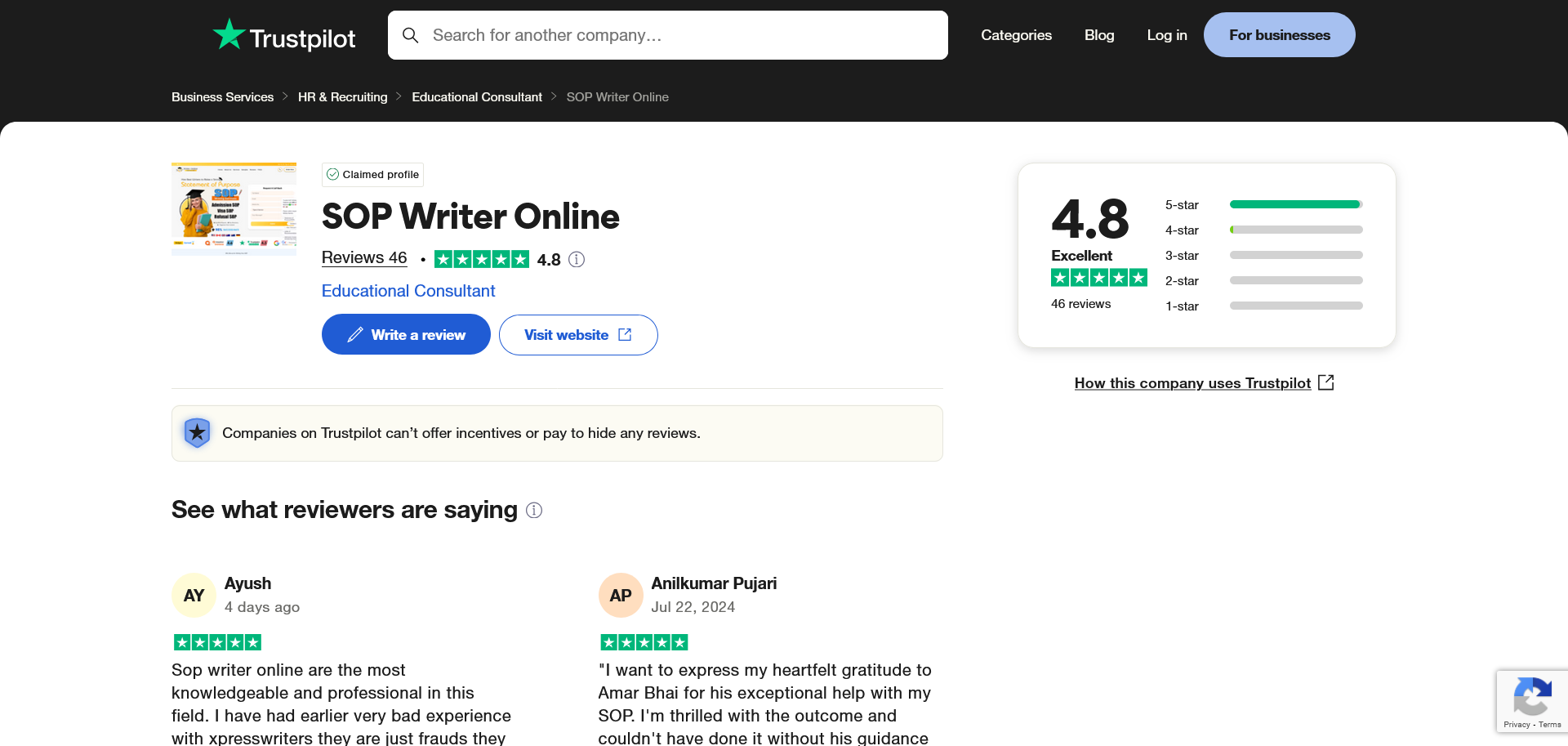
We have successfully written SOPs for 20,000+ students applying to universities in the USA, UK, Canada, Australia, and Europe. Our writers have experience with SOPs for prestigious institutions, and SOP writing is our full-time professional work, not an automated process.
Every SOP we write is:
- 100% human-written
- Plagiarism-free
- Customized for the university and course
- Written with admission and visa intent in mind
SOP Writing Services for the University of Ottawa
If you are applying to the Universities in USA, UK, Canada, Australia etc. and searching for reliable SOP writing help, we are here for you.
We also provide:
- Personal Statement Writing
- LOR Writing
- Letter of Motivation (LOM)
- SOP Writing
- Essay Writing
📌 Website:https://www.sopwriteronline.com
📲 WhatsApp / Call: +91-7983630647
You can directly discuss your profile and deadlines with our experts before starting. For Instant SOP Writing Help: What’s App us +91 7983630647
How to Improve a Canada Study Visa SOP After a Refusal
If a previous study permit application has been refused, begin by reviewing the refusal letter and identifying the concerns raised by the immigration officer.
The next application should address those concerns with relevant explanations and supporting evidence. Rewriting the SOP alone may not resolve issues relating to finances, eligibility, admissibility or other missing evidence.
Before applying again:
- Review the refusal reasons carefully.
- Identify the information or evidence that was missing, unclear or insufficient.
- Correct any factual inconsistencies in the application.
- Prepare a revised study plan that addresses the actual concerns.
- Ensure that financial and other supporting documents substantiate the claims made.
- Check the current requirements before submitting a new application.
A revised study plan should explain what has changed or what additional evidence now supports the application, where applicable. No document can guarantee a positive decision, and applicants should avoid submitting fabricated information or making promises that do not reflect their real circumstances.
Final Checklist Before Submitting Your University of Ottawa Application
Before submitting your application, make sure that you have:
- Checked the official requirements for your specific programme.
- Confirmed whether a Letter of Intent, Personal Statement, SOP or another document is required.
- Followed the prescribed word limit, page limit and formatting instructions.
- Explained your academic motivation and programme suitability clearly.
- Used accurate information about the University of Ottawa.
- Ensured that your academic history and future goals are represented honestly.
- Checked the separate requirements for your Canadian study permit, if applicable.
- Proofread all documents for clarity, grammar and consistency.
Get Professional Help With Your SOP or Letter of Intent
Preparing an effective university application document requires more than good grammar. The document should reflect your actual academic background, demonstrate a clear understanding of the programme and communicate your goals in a structured and credible way.
At SOP Writer Online, we help students organise their academic experiences, clarify their motivations and prepare application documents tailored to their individual profiles and stated requirements.
Whether you need help with a Statement of Purpose, Letter of Intent, Personal Statement or Canadian study visa SOP, the first step is to identify the exact requirements and review your background.
Planning to apply to the University of Ottawa? Visit SOP Writer Online to learn more about our application-writing support.
“`html








Post Comment