Newcastle University Personal Statement | Your Complete Guide for UCAS, Masters and PhD Applications
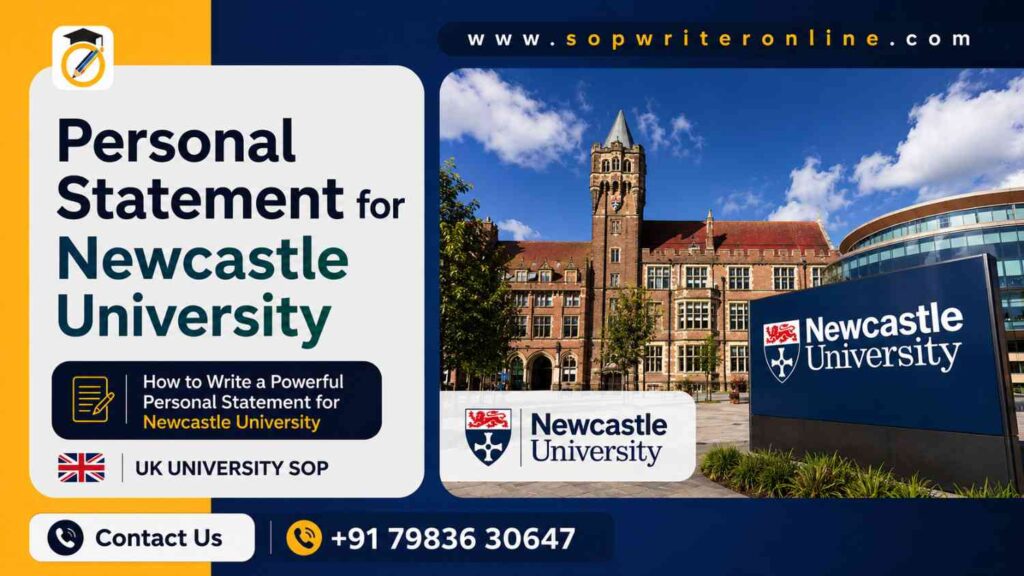
Writing a Newcastle University personal statement is one of the most important steps you will take when applying to one of the UK’s most respected Russell Group universities. Whether you are applying through UCAS as an undergraduate, preparing for a Masters programme, or stepping into the world of doctoral research, your personal statement is the moment where the admissions team stops looking at your grades and starts looking at you as a person. It is your voice on paper, and it needs to be honest, clear, and compelling.
This guide will walk you through everything, from the four key UCAS questions to crafting a strong postgraduate statement that can open doors at Newcastle.
For Personal Statement Writing Help: What’s App us +91 7983630647
Why Newcastle University Specifically?
Before you even write a single word, you need to understand why this question matters. Newcastle University is not just picking the most qualified student on paper. They are building a cohort of curious, driven, and thoughtful individuals who will contribute to their academic community.
Newcastle has a strong reputation in areas like medicine, law, engineering, and the humanities. If you are applying to their medical school, for instance, the competition is intense and your personal statement needs to reflect genuine clinical awareness. If you are applying to their business school or geography department, they want to see real intellectual engagement with the subject beyond the classroom.
So ask yourself honestly: why Newcastle? And let that answer shape everything you write.
Get Your Admission-Ready SOP Written by Experts
Your SOP can make or break your admission. Stand out with a professionally written Statement of Purpose that highlights your achievements, career goals, and unique story — tailored exactly for top universities in the USA, UK, Canada, Australia, and Germany.
UCAS Personal Statement: The Four Key Questions
From the 2027 UCAS cycle onwards, the personal statement format changed significantly. Instead of one long open-ended essay, applicants now answer four structured questions. This is actually great news because it gives you a clear framework to work within. Here is how to handle each one.
Question 1: Why Do You Want to Study This Course?
This is your opening and your most important answer. Start strong. Do not begin with a cliche like “Ever since I was young” or “I have always been passionate about.” Instead, open with a specific moment, a book you read, a problem you tried to solve, a conversation that shifted your thinking.
For example, if you are applying to Computer Science at Newcastle, you might open by mentioning a specific algorithmic challenge you encountered, and what it made you realise about how we solve complex problems. Connect that moment directly to why this particular field matters to you and why studying it formally at university level is the next logical step.
Show that you understand what the course actually involves. Look at Newcastle’s module descriptions, their research themes, and their teaching approach. Reference things that genuinely excite you about what you will be studying there.
Question 2: How Have Your Studies So Far Prepared You?
This is where your A-levels, BTECs, International Baccalaureate, or equivalent qualifications come in. But please do not just list your subjects. That is what your grades are for.
Instead, talk about specific skills, concepts, or moments of learning that are directly relevant to your chosen degree. If you studied Economics and you are applying to Politics and Economics, talk about a particular theory that challenged your thinking. If you are applying to Civil Engineering, talk about how your Physics and Maths studies helped you understand structural principles in the real world.
Be honest about what you found difficult too. Admissions tutors appreciate a student who acknowledges complexity and explains how they worked through it. It shows academic maturity.
Question 3: What Have You Done Outside of the Classroom?
This is your extracurricular section but think of it less as a CV and more as a conversation. Newcastle is looking for students who are curious and engaged beyond formal study.
This could be work experience, volunteering, a personal project, a part-time job, sports, music, or any leadership role you have taken on. The key is to always connect it back to your course. If you worked in a hospital for a week and you are applying to Nursing at Newcastle, do not just say you did the placement. Tell them what you observed, what questions it raised for you, and how it confirmed or deepened your interest in the field.
If you have done something unusual or taken an unconventional path, do not hide it. Own it. Authenticity stands out far more than a polished list of generic achievements.
Question 4: Why Are You Ready for University?
This final question is about maturity and self-awareness. Newcastle wants to know that you understand what university life demands, both academically and personally.
Talk about your ability to manage independent study. Mention any experience of working in teams, handling responsibility, or navigating challenges. If you have had to overcome something significant in your journey to reach this point, this is the appropriate place to mention it briefly and professionally.
End this section with forward-looking energy. Where do you want to go after Newcastle? What kind of graduate do you want to become? Showing that you have thought beyond the application itself tells the admissions team you are serious and ready.
Masters Personal Statement for Newcastle University
Applying for a Masters at Newcastle is a different exercise entirely. You are no longer an 18-year-old explaining your potential. You are a graduate making a case for why this specific programme, at this specific university, is the right next step for your career and your intellectual development.
Start with Your Main Keyword and Core Purpose
Your first paragraph should immediately state the subject of your Masters and why you are applying now. Do not warm up with background information. Lead with purpose.
For example: “Newcastle University’s MSc in Data Science offers exactly the combination of applied machine learning and ethical AI governance that I have been working toward since completing my undergraduate degree in Mathematics at the University of Delhi.”
That kind of opening tells the reader everything they need to know in the first two lines. It is confident without being arrogant.
Connect Your Undergraduate Work to the Masters
Spend a solid paragraph discussing your undergraduate dissertation or final year project if you have one. This is usually the strongest academic work you have done, and it is directly relevant. Explain your research question, your methodology, and what you found or concluded. Then draw a clear line between that work and what you want to explore in the Masters.
Bring in Professional Experience
If you have worked before applying for the Masters, this section matters a great deal. Newcastle’s postgraduate admissions teams are not just looking at academic credentials. They want to see that you have tested your knowledge in the real world and that the Masters will help you go further in a direction that already has momentum.
Be specific about your role, your responsibilities, and what you learned. Avoid vague language like “I gained valuable experience.” Instead, say what the experience actually taught you and how it connects to what Newcastle is offering.
Why Newcastle, Why This Programme?
This part is non-negotiable. You must research the programme thoroughly and mention it by name. Reference specific modules, faculty members whose work you admire, research centres associated with the department, or industry partnerships that excite you.
Generic personal statements that could apply to any university are immediately obvious to admissions tutors. A few specific, well-researched references to Newcastle’s own work will do more for your application than two paragraphs of general enthusiasm.
PhD Personal Statement for Newcastle University
A PhD personal statement is fundamentally different from anything you have written before. This is not just a statement of intent. It is the beginning of an academic argument.
Open with Your Research Focus
The first paragraph of your PhD personal statement must state your proposed research area clearly and confidently. Newcastle’s doctoral admissions process is largely about finding a fit between your research interests and the expertise of their academic staff. If your opening paragraph is vague, the rest of the statement will struggle to recover.
State what you want to investigate, why it matters, and why it has not been fully answered by existing scholarship. This shows you have done your literature review homework and that you understand where your work fits in the current academic conversation.
Demonstrate Research Experience
Talk about your Masters dissertation or any published work, conference presentations, or research placements. The PhD admissions committee is looking for evidence that you can actually do research, not just that you are interested in doing it.
Be honest about the limitations of your previous work too. Acknowledging where your Masters research fell short, and explaining how your PhD proposal addresses those gaps, is the sign of a genuinely mature researcher.
Outline Your Methodology
You do not need a full research proposal in your personal statement, but you do need to demonstrate that you have thought about how you will answer your research question. Mention whether your approach is qualitative or quantitative, what kinds of sources or data you will draw on, and what theoretical framework you are working within.
This tells your potential supervisor that you are not just curious about a topic. You have a plan.
Name Your Potential Supervisor
If you have identified a faculty member at Newcastle whose research aligns with yours, mention them by name and explain why their work is relevant to yours. Many successful PhD applicants at Newcastle have already made contact with their proposed supervisor before submitting their formal application. If you have had that conversation, a brief reference to it in your statement adds real credibility.
Our Writing Services — We’ve Got You Covered
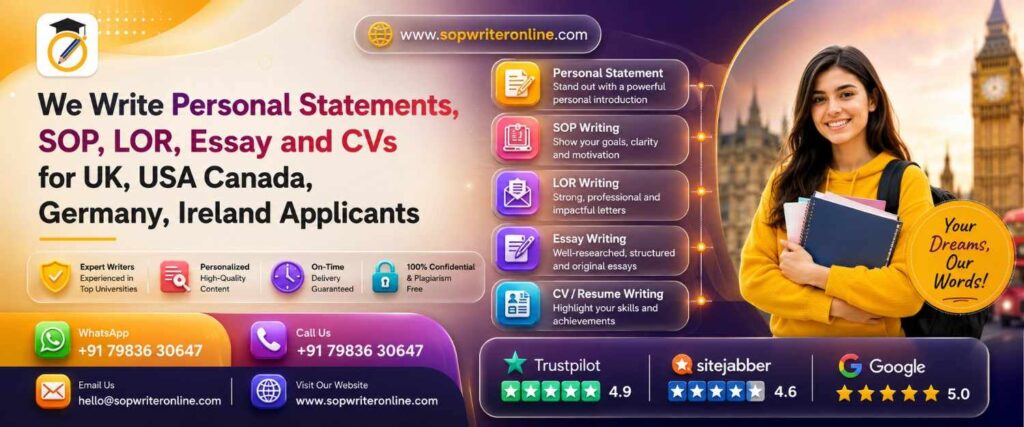
- Statement of Purpose (SOP)
- Letter of Recommendation (LOR)
- Personal Statement
- UCAS Essay
- Cover Letter
- Resume / CV
We write custom, plagiarism-free documents tailored to your university, course, and profile. Whether it’s Newcastle University, Oxford, or any other UK university — we know what works.
Common Mistakes to Avoid Across All Three Levels
There are a few things that consistently weaken personal statements, regardless of what level you are applying at.
Starting with a quote is one of them. Unless the quote is genuinely unusual and you are connecting it to something specific and personal, it reads as filler. Admissions tutors have seen every Aristotle and Einstein quote there is.
Writing in passive voice throughout makes your statement feel distant and lifeless. Use active, direct sentences.
- You did things.
- You thought things.
- You decided things.
Own your story.
Being vague about your motivations is another common trap. “I have always loved science” tells the reader nothing. “My chemistry teacher showed me how aspirin works at a molecular level and I spent the next three days trying to understand enzyme inhibition on my own” tells the reader something real.
And finally, do not neglect the ending. Many students write a strong opening and a strong middle and then run out of energy at the close. Your final paragraph should leave the reader with a sense of your direction, your readiness, and your genuine enthusiasm for what comes next.
Top Programmes at Newcastle University
Here is a look at some of the most popular and well-regarded programmes across undergraduate, Masters, and PhD levels at Newcastle. This can help you understand where the university really shines and give you a sharper focus when writing your personal statement.
| Programme | Level | Duration | Why It Stands Out |
|---|---|---|---|
| Medicine (MBBS) | Undergraduate | 5 years | Highly competitive with strong NHS clinical placements from Year 1 |
| Computer Science | Undergraduate | 3 years | Industry links, placement year option, strong AI and machine learning focus |
| Law (LLB) | Undergraduate | 3 years | Consistently high UK rankings with mooting and pro bono experience |
| Civil Engineering (BEng/MEng) | Undergraduate | 3 to 4 years | ICE accredited with real project-based learning from second year |
| Architecture (MArch) | Masters | 2 years | RIBA Part 2 accredited with a strong sustainability and studio culture |
| Data Science (MSc) | Masters | 1 year | Blends statistics, machine learning, and applied industry data work |
| International Business Management (MSc) | Masters | 1 year | Global cohort with strong links to corporations and consultancies |
| Marine Biology (MSc) | Masters | 1 year | Field research access along the Northumberland coastline |
| Biomedical Sciences (PhD) | Doctoral | 3 to 4 years | Strong NHS and pharmaceutical research ecosystem |
| Urban Planning and Design (PhD) | Doctoral | 3 to 4 years | Newcastle itself serves as a live research environment for urban scholars |
| English Literature (BA) | Undergraduate | 3 years | Broad period coverage with creative writing pathways available |
| Nursing (BNurs) | Undergraduate | 3 years | NHS-funded placements across the North East with excellent student support |
This table covers the areas where Newcastle consistently performs well in national rankings and graduate employment outcomes. If your programme is not listed here, do not worry. The personal statement principles in this guide apply across all subjects.
Final Thoughts
Your Newcastle University personal statement, whether for UCAS, a Masters, or a PhD, is ultimately a piece of writing about who you are and what you care about. The structure matters, the keywords matter, the research matters. But underneath all of that, what matters most is that the person reading it can hear a real voice with a real story and a real reason for being there.
Write it like you mean it. Because if you do not, no amount of clever structure will save it. And if you do, even an imperfect draft can be shaped into something genuinely strong. We helped many students securing the seat of their dream university we build strong SOPs, Personal Statements, LORs and Essay Contact us for Help: What’s App us +91 7983630647
Good luck. Newcastle is worth the effort.










Post Comment