US Student Visa Rules 2026: Federal Court Blocks Stricter Four-Year Rule for International Students
US Student Visa Rules 2026: What Has Changed?
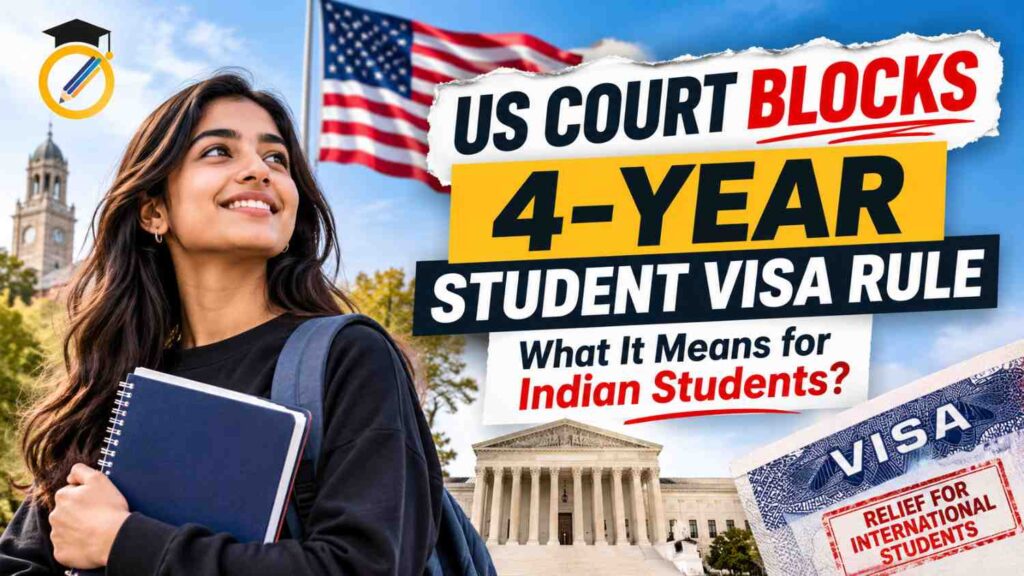
US student visa rules 2026 have taken an important turn after a federal court struck down a controversial immigration rule that sought to introduce fixed admission periods for international students. The decision, delivered on November 16, 2026, provides significant relief to students planning to pursue higher education in the United States.
The US District Court for the District of Massachusetts ruled against the Department of Homeland Security (DHS), setting aside its final rule that proposed replacing the longstanding Duration of Status policy with a fixed admission period of up to four years.
The ruling is particularly important for international students pursuing postgraduate degrees, doctoral research, joint academic programmes and other courses that may require more than four years to complete.
For Indian students considering universities in the United States, this development brings some relief amid ongoing discussions about immigration policies, student visa restrictions and international enrolment.
What Was the Four-Year Student Visa Rule Proposed by the US Government?
The Department of Homeland Security had introduced a new regulation in July 2026 that aimed to change how long international students could remain in the United States.
Under the proposed system, certain international students holding F-1 visas would no longer be admitted under the traditional Duration of Status framework. Instead, they would receive a fixed admission period linked to their academic programme, subject to a maximum of four years.
Students who needed additional time to complete their education would have been required to apply for an extension of stay through the relevant immigration authorities.
The proposed regulation also introduced additional restrictions concerning academic progression and institutional transfers.
Some of the major proposed changes included:
- A maximum four-year admission period for eligible international students.
- Additional extension procedures for students requiring more time.
- Greater restrictions on changing academic programmes or educational objectives.
- Additional limitations on transferring between educational institutions.
- Potential difficulties for students pursuing joint degrees or longer doctoral programmes.
These changes raised concerns among universities, international education organisations and students who believed the new requirements could create unnecessary administrative difficulties.
Need Help Writing a Strong SOP or Personal Statement?
A well-written Statement of Purpose can significantly improve your chances of admission to top universities worldwide. Our professional writers craft personalized SOPs that clearly present your academic background, career goals, and achievements in a compelling and structured way.
Why Did the Federal Court Block the New Student Visa Rule?
On November 16, 2026, Judge F. Dennis Saylor IV of the US District Court for the District of Massachusetts delivered a final judgment in favour of organisations challenging the DHS regulation.
The case involved a coalition of higher education associations and labour organisations, including NAFSA and the Presidents’ Alliance on Higher Education and Immigration.
The court found that the Department of Homeland Security had not adequately justified the proposed restrictions or properly considered their potential consequences.
There were several important reasons behind the decision.
1. Lack of Adequate Justification
The government had cited concerns about immigration fraud and national security to support the proposed restrictions.
However, the court found that DHS had not sufficiently demonstrated how introducing a fixed four-year admission period would address these concerns.
2. Failure to Consider Existing Monitoring Systems
The court also highlighted that the government had not adequately considered whether existing monitoring mechanisms, particularly the Student and Exchange Visitor Information System (SEVIS), could address its concerns.
SEVIS already allows authorities and educational institutions to monitor important information about international students and their academic progress.
3. Restrictions on Academic Opportunities
Another significant concern involved the proposed restrictions on academic mobility.
The regulation could have affected students who wanted to change their academic concentration, transfer institutions, pursue additional qualifications or enrol in longer research programmes.
The court concluded that these restrictions were not reasonably related to the purpose of the F-1 student visa programme.
As a result, the court vacated the entire final rule under the Administrative Procedure Act.
What Is the Duration of Status Policy for F-1 Students?
To understand the importance of this decision, international students should know what Duration of Status actually means.
Duration of Status, commonly written as D/S, is the traditional framework under which eligible F-1 students can remain in the United States while maintaining their immigration status and making normal progress towards completing their approved academic programme.
Unlike a fixed four-year admission period, this framework does not automatically require students to apply for an extension simply because four years have passed.
For example, consider an Indian student enrolling in a PhD programme at a US university.
A doctoral programme may require five or six years, depending on the research, academic requirements and progress of the student.
Under the proposed four-year system, the student could have faced additional extension procedures after reaching the four-year limit.
With the court’s latest decision, the longstanding Duration of Status framework is preserved, subject to applicable immigration requirements.
This provides greater certainty for students whose academic journeys require additional time.
How Will the US Court Decision Affect Indian Students?
The latest ruling is particularly relevant to Indian students because the United States remains an important destination for students seeking international qualifications, research opportunities and specialised academic programmes.
Here are some areas where the decision may make a difference.
1. More Certainty for Students Pursuing Master’s and PhD Programmes
Students enrolling in postgraduate and doctoral programmes can benefit from the continuation of the Duration of Status framework.
Research-based programmes, in particular, may require additional time due to research activities, thesis submissions and other academic requirements.
2. Greater Flexibility in Academic Planning
Students may have legitimate reasons to change their academic concentration, pursue an additional qualification or transfer to another university.
The court’s decision prevents the restrictions contained in the vacated rule from taking effect.
3. Reduced Concerns About Additional Extension Procedures
Under the proposed regulation, students would have faced additional immigration paperwork after reaching the fixed admission limit.
The court’s decision removes this specific requirement introduced by the new rule.
4. Greater Confidence for Students Planning to Study in the USA
Immigration uncertainty can influence students’ decisions about where to pursue higher education.
The latest ruling offers some reassurance to international applicants who were concerned about the potential impact of the proposed four-year restriction.
However, students should understand that this decision does not remove all US immigration requirements or guarantee visa approval.
Does the Court Decision Affect F-1 Visa Validity and OPT?
This is an important distinction that international students should understand.
The court ruling concerns the Duration of Status framework and the proposed fixed admission period. It does not automatically change the validity of an individual’s F-1 visa stamp or provide new employment authorisation.
Students should understand the difference between the following:
F-1 Visa: The visa issued by a US embassy or consulate that allows an eligible student to travel to a US port of entry and request admission.
Form I-20: A document issued by an SEVP-certified educational institution containing important information about the student’s academic programme and eligibility for F-1 status.
Duration of Status: The immigration framework under which an eligible F-1 student can remain in the United States while maintaining the required student status.
Optional Practical Training (OPT): A separate employment authorisation benefit that allows eligible F-1 students to gain practical work experience related to their field of study, subject to applicable requirements.
The November 2026 court decision does not independently extend OPT periods or change existing OPT eligibility criteria.
Students should continue following their university’s international student office guidance and applicable immigration regulations.
What Should Indian Students Planning to Study in the USA Do Now?
Although the court decision is positive news, prospective applicants should continue preparing their applications carefully.
Here are some practical steps to consider:
- Research universities carefully: Select institutions based on academic quality, programme structure, tuition fees and career opportunities.
- Prepare your admission documents: Keep your academic transcripts, recommendation letters, Statement of Purpose and other application documents ready.
- Understand F-1 visa requirements: Familiarise yourself with the financial documentation, admission requirements and visa interview process.
- Follow official immigration updates: Immigration regulations can change, and students should rely on official government announcements rather than social media discussions.
- Stay in contact with your university: Students already enrolled in US institutions should consult their Designated School Official (DSO) regarding questions about their immigration status.
Students preparing their university applications should also pay attention to their Statement of Purpose. A well-organised SOP should explain their academic background, reasons for selecting a particular programme, future objectives and motivation for studying in the United States.
For additional guidance, read our article on Statement of Purpose for MBA in the USA.
Can the US Government Appeal the Court’s Decision?
Yes. The November 16 judgment does not mean that immigration policy debates surrounding international students have permanently ended.
The US government may challenge the decision through the appellate process.
According to the available reporting, the government had already appealed an earlier preliminary injunction issued in September 2026. The final judgment now provides a separate legal development in the same dispute.
For students, this means staying informed about further legal proceedings and any official immigration guidance is important.
At present, the November 16 court judgment has vacated the DHS final rule, preserving the longstanding Duration of Status framework.
Frequently Asked Questions (FAQs)
1. Did the US court cancel the four-year student visa rule in November 2026?
Yes. On November 16, 2026, the US District Court for the District of Massachusetts vacated the DHS final rule that proposed fixed admission periods of up to four years for international students and certain other nonimmigrants.
2. Can Indian students still study in the USA under the F-1 visa?
Yes. The court’s decision does not cancel the F-1 student visa programme. Indian students can continue applying for admission to eligible US institutions and seeking F-1 visas under the applicable requirements.
3. Does the ruling mean international students can stay in the USA indefinitely?
No. Duration of Status does not provide an unlimited right to remain in the United States. Students must maintain their immigration status, follow applicable regulations and satisfy the requirements of their academic programme.
4. Will students pursuing PhD programmes benefit from this decision?
The ruling is particularly relevant to doctoral students because research programmes can take longer than four years. Preserving the Duration of Status framework avoids the additional fixed-period extension requirement introduced by the vacated rule.
5. Does the ruling change OPT eligibility for international students?
No. The judgment specifically addresses the DHS rule concerning fixed admission periods and academic mobility. It does not independently change existing OPT eligibility requirements.
6. Should students planning to study in the USA in 2027 change their plans?
Students do not need to change their academic plans solely because of the proposed four-year rule, as that rule has been vacated. However, they should continue monitoring official immigration developments and prepare their applications according to current requirements.
Final Thoughts
The federal court’s November 16, 2026 decision is an important development for international education in the United States.
By vacating the proposed four-year admission rule, the court has preserved the longstanding Duration of Status framework and prevented additional restrictions on academic mobility from taking effect under that regulation.
For Indian students planning to pursue undergraduate, postgraduate or doctoral education in the United States, the decision provides greater clarity about the immigration framework governing their academic journey.
However, immigration policies continue to evolve. Students should remain informed, follow official guidance and prepare their university and visa applications with proper attention to their academic and financial documentation.
At SOP Writer Online, we understand that preparing a strong university application requires more than simply submitting academic documents. A well-written Statement of Purpose or Personal Statement helps applicants communicate their educational background, career objectives and reasons for choosing a particular university and programme.
Students planning to apply to universities in the USA can explore our professional SOP writing services for application guidance and document preparation.
Sources and Further Reading
- NAFSA: Federal Court Rules in Favor of Coalition Challenging Rule Ending Duration of Status
- US District Court: Memorandum and Order, November 16, 2026 (PDF)
- Telangana Today: Relief for Foreign Students as US Federal Court Blocks DHS Admission Rule
Last Updated: November 18, 2026












Post Comment