Personal Statement for Cambridge University | Best SOP Writing
Personal Statement for Cambridge University: From UCAS word limits to postgraduate research proposals — this is the only Cambridge personal statement guide you will need before you start writing.
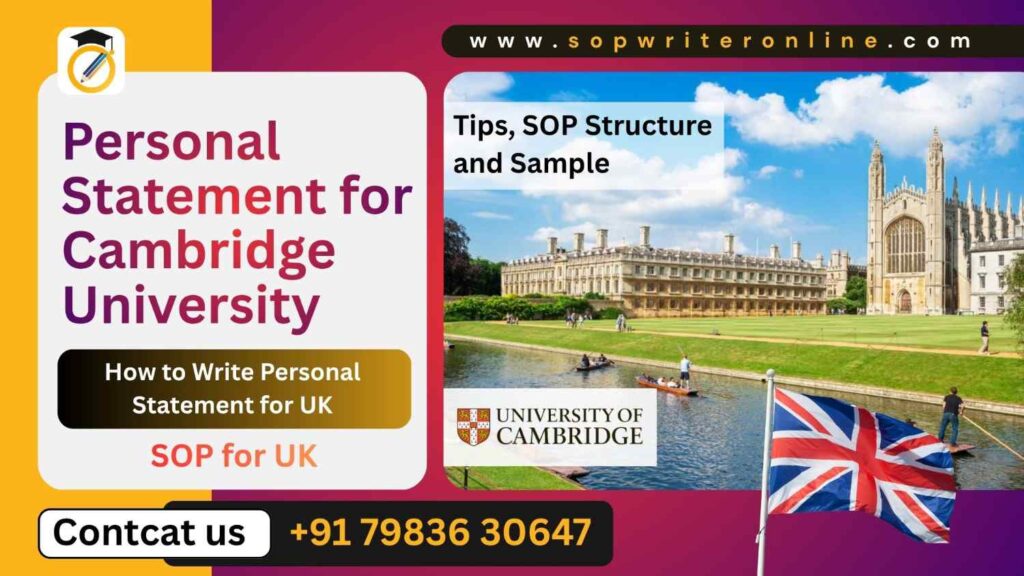
Writing a personal statement for Cambridge University is, without question, one of the most high-stakes pieces of writing you will ever produce. Cambridge consistently ranks among the top three universities in the world, and its admissions process is notoriously rigorous — every sentence of your personal statement is read, re-read, and evaluated by faculty who interview thousands of applicants every year. Whether you are applying as an undergraduate through UCAS or submitting a postgraduate research proposal directly to the University, the rules of the game are different here than they are anywhere else.
This guide breaks down everything — the word limits, the structure, what Cambridge tutors actually look for, the UCAS process, specific advice for competitive programmes like Computer Science, and why having a professional write your statement is not just a luxury but a strategic advantage.
For Personal Statement Writing Help: What’s App us +91 7983630647
Does Cambridge Accept UCAS Applications?
Yes — absolutely. If you are applying to Cambridge as an undergraduate, you must apply through UCAS (Universities and Colleges Admissions Service), exactly as you would for any other UK university. Cambridge is fully integrated into the UCAS system. You can list Cambridge as one of your five UCAS choices (note: you cannot apply to both Oxford and Cambridge in the same cycle).
The UCAS personal statement for Cambridge is the same document submitted to all five of your UCAS choices. This is an important point that many international applicants miss: you write one statement, and every university on your list reads it. This means your UCAS personal statement must be strong enough to impress Cambridge while remaining coherent to other universities on your list.
Key UCAS Deadlines for Cambridge: The UCAS deadline for Oxford and Cambridge is earlier than for other universities — typically 15 October each year (check UCAS for the exact date for your cycle). Missing this deadline means you cannot apply to Cambridge that year, no exceptions.
For postgraduate applications, the process is different. Cambridge postgraduate applicants apply directly through the University’s own Graduate Admissions portal, not through UCAS. The statement you submit in that process is often called a “research proposal” or “statement of purpose” and is longer and more specialised than the UCAS format — more on that below.
Get Your Admission-Ready SOP Written by Experts
Your SOP can make or break your admission. Stand out with a professionally written Statement of Purpose that highlights your achievements, career goals, and unique story — tailored exactly for top universities in the USA, UK, Canada, Australia, and Germany.
Cambridge Personal Statement Guide for Undergraduates
The UCAS personal statement gives you 4,000 characters (approximately 47 lines) to make your case. Cambridge tutors are looking for one thing above everything else: genuine intellectual passion for your subject. Not generic enthusiasm. Not vague career goals. Specific, demonstrable, academic engagement with your chosen field.
The Structure That Works
There is no single “correct” format, but the following structure is used successfully by the majority of Cambridge offer-holders:
- Opening hook (1–2 sentences): A specific question, observation, or encounter with your subject that made you think differently. Not “I have always loved biology.” Something sharper.
- Academic engagement (40–50% of the statement): Books you have read beyond the syllabus, lectures attended, papers studied, competitions entered. Be specific — name the books, authors, concepts.
- Super-curricular activities (20–30%): Work experience, research projects, extended essays, online courses that connect directly to your subject.
- Broader skills and interests (10–15%): Leadership, music, sports, volunteering — briefly, and only if genuinely relevant.
- Closing statement: One or two lines on where your intellectual curiosity is taking you next. Forward-looking, not a list of future jobs.
“Cambridge tutors read thousands of statements per year. The ones that get shortlisted are the ones that sound like they were written by someone already thinking like an undergraduate.”
What Cambridge Tutors Actually Look For
Cambridge uses personal statements primarily as material for interview preparation. Tutors will ask you about anything you have written — so never include a book you have not fully read or a concept you cannot discuss comfortably under pressure. The statement is a conversation starter, not a checklist.
Do This
- ✔ Name specific books, papers, and lectures
- ✔ Analyse ideas, don’t just list them
- ✔ Show you have gone beyond the A-level syllabus
- ✔ Write in an academic, confident tone
- ✔ Connect your interests into a coherent narrative
- ✔ Address your subject directly — not a career
Don’t Do This
- ✖ Open with a quote from a famous person
- ✖ List achievements without reflection
- ✖ Mention wanting to “make a difference”
- ✖ Repeat your predicted grades
- ✖ Use buzzwords like “passionate” without evidence
- ✖ Write about multiple subjects at once
Personal Statement Cambridge Computer Science
Computer Science at Cambridge is one of the most competitive courses in the UK — the course, officially called the Computer Science Tripos, consistently attracts thousands of applicants for a few hundred places. A strong personal statement for Cambridge Computer Science looks significantly different from a generic technology essay.
Cambridge Computer Science is highly mathematical. Your statement must demonstrate mathematical maturity and theoretical curiosity, not just practical programming experience. Tutors want to see that you understand CS as a rigorous academic discipline, not a trade skill.
What to Include for CS
- Evidence of engagement with CS theory — algorithms, complexity, formal logic, discrete mathematics
- Self-directed projects or competitive programming (USACO, IOI, Codeforces) with reflection on what you learned, not just what you built
- Books and resources beyond school: Knuth’s TAOCP, SICP, research papers from arXiv
- Mathematical interests — the Cambridge CS course requires A-level Further Maths; show you love it
- Any genuine research exposure: EPQ, university taster programmes, mentored projects
A common mistake: Applicants spend half their CS personal statement describing their app or game project in detail. Tutors care about the thinking behind the project — the data structures chosen, the algorithmic trade-offs made, the mathematical constraints tackled — not the product.
Cambridge Personal Statement Postgraduate
The cambridge personal statement postgraduate process is a different beast entirely. When applying for a Master’s (MPhil, LLM, etc.) or a PhD at Cambridge, you submit your application through the Applicant Portal at www.graduate.study.cam.ac.uk — not through UCAS.
The postgraduate personal statement (often called a “Statement of Purpose” or “Research Proposal”) is longer — typically 500 to 1,500 words depending on the programme — and must demonstrate academic maturity, research readiness, and a clear fit with Cambridge’s research environment.
Key Differences: UG vs Postgraduate Statement
- Research focus: A postgraduate statement must clearly articulate your intended research area, methodology, and why Cambridge specifically (name the supervisor you want to work with if possible)
- Publication and conference record: If you have published or presented work, even at undergraduate level, mention it
- Supervisor fit: Cambridge PhD applications are far more likely to succeed when a potential supervisor has been contacted in advance and is aligned with your project
- Funding: Mention any scholarships you are applying for (Gates Cambridge, Cambridge Trust) as part of your overall application narrative
MPhil vs PhD statements: MPhil applications require you to demonstrate academic excellence and readiness for postgraduate study. PhD applications require a detailed research proposal, usually 1,000–2,000 words, showing your command of existing literature, a gap in knowledge, and your methodological approach to addressing it.
Seven Writing Tips for a Standout Cambridge Statement
Whether undergraduate or postgraduate, these principles separate the statements that get shortlisted from the ones that get rejected:
- Lead with intellect, not biography. Start with an idea, a problem, a discovery — not your personal history.
- Be specific in everything. Not “I read widely in economics” but “Reading Kahneman and Thaler’s work on behavioural economics challenged my assumption that markets were rational.”
- Write in one continuous narrative arc. The best statements feel like a single sustained argument, not a list of accomplishments.
- Edit ruthlessly. With 4,000 characters, every word is load-bearing. Read it aloud. Cut anything that does not earn its place.
- Avoid the phrase “ever since I was young.” It is the most overused opening in UCAS history and immediately signals a generic statement.
- Get it reviewed by someone who knows Cambridge. A subject teacher or tutor who understands the Oxbridge standard is invaluable.
- Do not over-polish into blandness. Cambridge wants a real voice — confident, curious, intellectually alive. Too much editing removes that.
Why Your Personal Statement Is Too Important to Leave to Chance
Here is an uncomfortable truth: you are competing against applicants who have been preparing for this moment for years. Some of them are working with professional writers, tutors, and consultants who have helped dozens of candidates get Cambridge offers. You are talented — but talent alone does not guarantee that your writing will reflect your capability. Academic brilliance and the skill of writing a compelling, strategically structured personal statement are two very different things.
Most students write their personal statements in the middle of A-level revision, university fairs, and extracurricular commitments. The result, even from brilliant students, is often a rushed, under-edited document that undersells everything they have done. A professional writer who works on statements every single day sees the patterns, knows what Cambridge tutors look for, and can take your raw material and shape it into something genuinely compelling.
We Write Statements That Get Cambridge Offers
We are a team of professional SOP and personal statement writers with direct experience in UK and international admissions. and we write every single day. and we have already helped candidates crack Cambridge, Oxford, LSE, MIT, and top programmes worldwide.
UCAS Personal Statement
Crafted to Cambridge’s exact standard. Intellectually engaging, subject-specific, interview-ready. Full drafts with unlimited revisions.
Statement of Purpose (SOP)
For MPhil, PhD, and Master’s applications worldwide. Research-aligned, supervisor targeted, academically rigorous.
Letter of Recommendation (LOR)
Professionally drafted LORs that sound authentic and highlight exactly what admissions committees want to read.
Essays & Supplements
Scholarship essays, “Why Cambridge” supplements, motivational letters — every document in your application, done right.
For Personal Statement Writing Help: What’s App us +91 7983630647
Why a Professional Writer Beats DIY — Every Time
01
We do this every single day. We know what Cambridge tutors shortlist — because we have seen it work, repeatedly.
02
We have already cracked top programmes — Cambridge, Oxbridge, Ivy League, LSE, Imperial. Our track record is real.
03
You can write well. We write strategically. There is a difference — and at Cambridge’s acceptance rate, strategy matters.
04
We match your voice. Every statement we write sounds like you — just the best, clearest, most compelling version of you.
05
Unlimited revisions until you are completely satisfied. We do not hand over a document and walk away.
06
Fast turnaround — even for urgent UCAS or postgraduate deadlines. We have handled 48-hour requests successfully.
Ready to write a statement that gets you shortlisted? Let’s talk.
GET A FREE CONSULTATIONTop Courses in Cambridge University
| # | Course | Degree | Faculty | Duration | Application route |
|---|---|---|---|---|---|
| 01 | Computer Science | BA / MEng | Computer Science & Technology | 3–4 yrs | UCAS |
| 02 | Natural Sciences | BA / MSci | Science | 3–4 yrs | UCAS |
| 03 | Engineering | BA / MEng | Engineering | 3–4 yrs | UCAS |
| 04 | Economics | BA | Economics | 3 yrs | UCAS |
| 05 | Law (LLB) | BA | Law | 3 yrs | UCAS |
| 06 | Medicine (MBBS) | MB BChir | Clinical Medicine | 6 yrs | UCAS |
| 07 | Mathematics | BA / MMath | Mathematics | 3–4 yrs | UCAS |
| 08 | Architecture | BA | Architecture | 3 yrs | UCAS |
| 09 | Philosophy | BA | Philosophy | 3 yrs | UCAS |
| 10 | Linguistics | BA | Modern & Medieval Languages | 3 yrs | UCAS |
| 11 | Psychology & Behavioural Sciences | BA | Psychology | 3 yrs | UCAS |
| 12 | History | BA | History | 3 yrs | UCAS |
| 13 | MPhil in Advanced Computer Science | MPhil | Computer Science & Technology | 1 yr | Direct portal |
| 14 | MPhil in Economics | MPhil | Economics | 1 yr | Direct portal |
| 15 | LLM (Master of Law) | LLM | Law | 1 yr | Direct portal |
Final Thoughts
The personal statement for Cambridge University is not just an application formality — it is the document that determines whether you get an interview, and the interview determines whether you get an offer. At an acceptance rate hovering around 20% for undergraduates and even lower for competitive postgraduate programmes, the quality of your writing is one of the very few things you can control.
Use this guide to understand the structure, the standards, and the strategy. If you are applying through UCAS, start early — September at the latest for an October deadline. If you are applying for a postgraduate programme, contact potential supervisors before you submit. And if you want to make absolutely certain your statement is performing at the level Cambridge demands, reach out to our team. We have done this before. We will do it for you.
Quick Recap: Cambridge undergraduate applications go through UCAS (4,000 characters, due 15 October). Postgraduate applications go through Cambridge’s Graduate Admissions portal directly. Both require subject-specific, intellectually rigorous writing. Both can benefit enormously from professional guidance.









Post Comment