SOP for Cloud Computing | Best SOP Writing and Guide
SOP for cloud computing is more than just a mandatory document—it’s your opportunity to demonstrate technical clarity, career vision, and readiness for an evolving digital ecosystem driven by AI, DevOps, and distributed systems.
If you’re applying for a Master’s program, postgraduate diploma, or specialized certification, your statement of purpose for cloud computing plays a decisive role in admission decisions. Universities want to know not just what you’ve done—but why you want to build a career in cloud computing and how their program aligns with your long-term goals.
In this comprehensive guide, we’ll walk you through how to write a powerful SOP for masters in cloud computing, share structural tips, and explain what makes a strong personal statement for cloud computing stand out.
For Instant SOP Writing Help: What’s App us +91 7983630647
Why an SOP for Cloud Computing Matters
Cloud computing is no longer just a trend—it’s the backbone of digital transformation. With organizations migrating to AWS, Azure, and Google Cloud platforms, universities are looking for candidates who:
- Understand cloud architecture and deployment models
- Have hands-on exposure to virtualization, DevOps, containers, or microservices
- Demonstrate problem-solving ability and analytical thinking
- Show clarity in career goals (Cloud Engineer, Solutions Architect, DevOps Specialist, etc.)
Your SOP should reflect both your technical foundation and your strategic mindset.
Need Help With SOP for Cloud Computing?
A strong SOP for Cloud Computing showcases your technical foundation, cloud architecture knowledge, DevOps exposure, and long-term career vision. Top universities expect clarity, structure, and a goal-driven narrative.
Structure of a Strong SOP for Masters in Cloud Computing
Here’s a proven structure that works:
1. Introduction – Your Motivation
Start with a compelling hook. Avoid generic lines like “I have always been passionate about computers.” Instead, connect your interest in cloud computing to a real problem, project, or technological shift.
Example direction:
- A project where you optimized server costs using virtualization
- Exposure to distributed systems during undergraduate studies
- Internship experience with cloud deployment
Make it personal, specific, and authentic.
2. Academic Background
Discuss:
- Your undergraduate degree (Computer Science, IT, Electronics, etc.)
- Relevant subjects (Operating Systems, Distributed Systems, Networking, Database Systems)
- Key projects related to cloud, DevOps, or scalable architectures
If you’ve worked on AWS EC2 instances, Docker containers, Kubernetes clusters, or CI/CD pipelines—mention them clearly.
This section builds technical credibility.
3. Professional Experience (If Applicable)
If you have work experience, highlight:
- Cloud migration projects
- Infrastructure automation
- DevOps implementations
- Performance optimization initiatives
Quantify results wherever possible.
Instead of:
“I worked on cloud deployment.”
Write:
“I helped migrate a monolithic application to a microservices-based architecture deployed on AWS, reducing server costs by 28%.”
Numbers add power.
4. Why This University?
This is where many applicants fail.
Your statement of purpose for cloud computing should include:
- Specific subjects offered (e.g., Cloud Security, Distributed Systems, Edge Computing)
- Faculty research interests
- Lab facilities or industry collaborations
- Internship opportunities
Make it tailored. Avoid copy-paste language.
5. Career Goals
Your short-term goal could be:
- Cloud Solutions Architect
- DevOps Engineer
- Cloud Security Specialist
Long-term goal:
- Lead scalable infrastructure for enterprise systems
- Build cloud-native SaaS platforms
- Launch a cloud consultancy
Universities prefer applicants with clarity and direction.
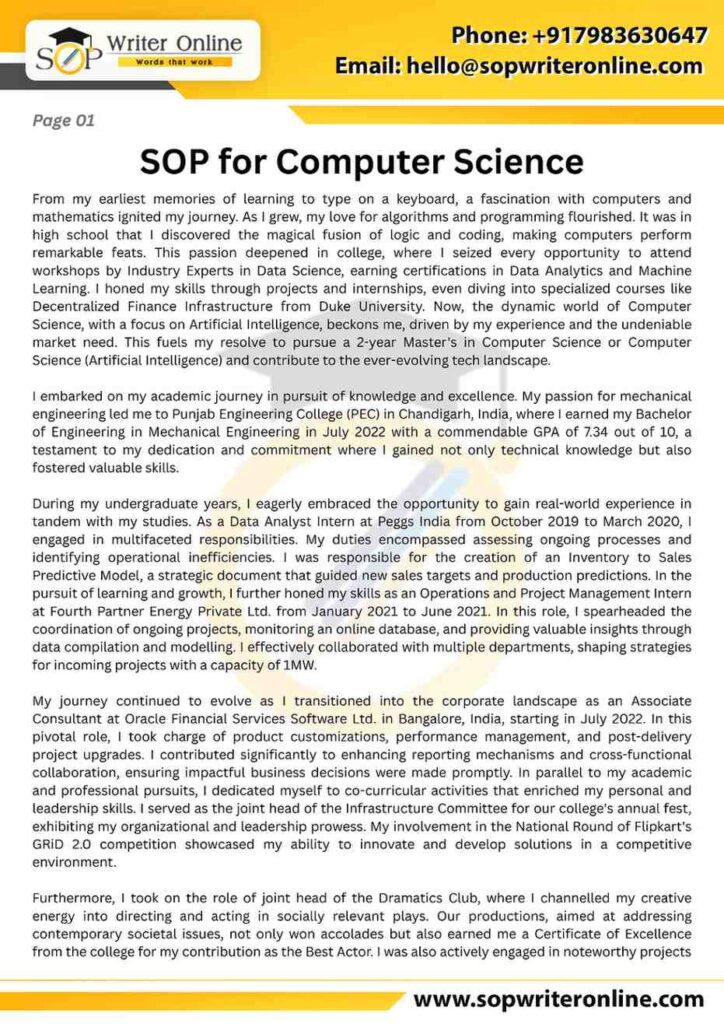
Sample SOP for Cloud Computing (Short Excerpt)
Here’s a brief sample SOP opening paragraph for reference:
The evolution of distributed computing and scalable infrastructure has transformed how modern enterprises operate, and it was during my undergraduate project on containerized application deployment that I recognized the transformative power of cloud computing. This realization motivated me to pursue advanced studies in cloud technologies, where I can deepen my understanding of distributed architectures, virtualization, and secure cloud environments.
(Your full SOP should typically be 800–1200 words depending on university guidelines.)
For Instant SOP Writing Help: What’s App us +91 7983630647
Common Mistakes to Avoid
- Writing a generic SOP not tailored to cloud computing
- Overloading it with technical jargon without context
- Copying a template without personalization
- Ignoring career clarity
- Weak conclusion
Your personal statement for cloud computing must feel human, focused, and structured—not robotic or keyword-stuffed.
Why Professional SOP Assistance Makes a Difference

Writing a strong SOP for University Application requires more than English fluency—it requires strategy, positioning, and narrative clarity.
We help applicants by:
- Conducting one-on-one profile discussions
- Structuring your technical journey effectively
- Highlighting achievements strategically
- Aligning your goals with university expectations
- Ensuring plagiarism-free, human-written content
Whether you need a complete statement of purpose for cloud computing, editing support, or a customized sample SOP for cloud computing, our team crafts documents that reflect your individuality and ambition.
Your story deserves to be presented professionally. For Instant SOP Writing Help: What’s App us +91 7983630647
Top Universities for Cloud Computing (Masters)
| University | Program | Location | Duration |
|---|---|---|---|
| Carnegie Mellon University | MS with Cloud Focus | USA | 1.5–2 years |
| University of Illinois Urbana-Champaign | MS Computer Science (Cloud) | USA | 1–2 years |
| Georgia Institute of Technology | MS Computer Science (Distributed/Cloud) | USA | ~1.75 years |
| Newcastle University | MSc Cloud Computing | UK | 1 year |
| University of Leeds | MSc Advanced Computer Science (Cloud) | UK | 1 year |
| Nottingham Trent University | MSc Cloud & Enterprise Computing | UK | 1–2 years |
| Imperial College London | MSc Computing (Cloud & Distributed Systems) | UK | 1 year |
| University of Toronto | MSc Applied Computing (Cloud Electives) | Canada | 1–2 years |
| University of Melbourne | Master of Information Technology (Cloud Pathway) | Australia | 2 years |
| University of British Columbia | MSc (Cloud-related focus) | Canada | 2 years |
| Simon Fraser University | Master’s in Cloud Technologies | Canada | 2 years |
Conclusion
A well-written SOP for masters can significantly strengthen your application. It’s your voice, your vision, and your value proposition—all in one document.
If you’re serious about securing admission to top global universities, don’t leave your personal statement for cloud computing to chance.
Let’s build an SOP that doesn’t just meet requirements—but sets you apart. For Instant SOP Writing Help: What’s App us +91 7983630647








Post Comment